Spoiled

It is common to hear people talking about “spoiled children” or a “spoiled child.”  

In our family we did not talk about a spoiled child until Amanda was born. Having two boys only 17 months apart in age, we did not talk about either boy being “spoiled.” When that cotton-top little girl named Amanda appeared on the scene, the boys were as guilty as their parents in spoiling her. 

As a preschooler in Burkina Faso, Amanda had only one local playmate, Janeen, who was our house helper’s daughter. Most children of all ages—even four-year olds—were kept busy all day helping with chores, hauling water or working in the fields. There was little play time for village children. Janeen’s dad worked for us so their family had a steady income and did not have to farm to grow food for their family, so she was able to play each day with Amanda. 

When Allison joined our clan Amanda was four years old. Amanda, the boys and Janeen all participated in spoiling her—along with her parents! There is four years difference in our girls’ ages, so Allison came along at just the right time for Amanda to pretend that she was her real baby.

Allison was definitely the most spoiled of our children. Maybe that’s because she is the fourth child, or she is the baby of the family. Regardless of the birth order, her three siblings doted on her so much that Allison was queen of the house.  

As parents we did not consider ourselves as heavy disciplinarians. We were firm with our kids for sure. I admit that I was less firm with our fourth child because I really did not need to be firm with Allison. Sometimes whenever Allison did something wrong, I did not have to say a word. I could just look at her a certain way, and she would lower her chin and look away from me. What a sad face! Whenever I gave her the “look,” she understood that she had done something that she should not have done, and she had that repentant reaction.

Isn’t it interesting how Allison’s reactions to her father’s “look” made her know that she had done something that displeased her father? The same is true with our Heavenly Father: we know when we miss the mark with Him without a word being spoken to us—and not even a “look.” 

Lord, as we walk with you, guide us to be so in tune with You that we don’t need a word or a look from you to know when we are not pleasing You. 

Dirty Clothes

When we lived in Burkina Faso most people in the country did not have any way to wash their clothes except by hand. The clothes washing duties fell to women and children. It was not unusual to see a group of women gathered around a “watering hole” doing their washing. A watering hole would usually be a hole dug out in the sand in a dry river bed where water would seep into the hole, and the women would dip water out of the hole with a calabash (gourd) bowl.

It would be 100 degrees plus with a humidity of about 10-15% most of the time, so drying was easy. but here’s the twist: when the women would finish washing a piece of clothing, they would stretch it out on the sand. Yes, on the sand! When the clothes would dry (usually in a matter of minutes) interestingly enough they would shake the clothes briskly and there would be no sand on the clothing!

We had the only washing machine within two hours of our home, so we were very fortunate indeed. We thought we were doing a good job getting our clothes clean until we returned to the USA.

When we returned to the US after resigning from our service in West Africa, we brought very few things back to the states with us. We picked out our very best clothes and packed them in our luggage.

The first day after arriving at my parents’ home, my mother told us to pile all our clothes near the washing machine—not just our dirty clothes but all of our clothes.

After washing a load she hung them out on the clothesline (oh, by the way that is a wire stretched between two posts and the purpose is to dry your newly washed clothes in the fresh air and sunshine). After hanging out a couple of loads she came inside and informed us that we needed to buy all new clothes.

We thought how ridiculous that was until Mom marched Cheryl and me outside to the clothesline to look at our white clothes compared to their white clothes. Our whites were all a tan color. Without any more discussion we agreed with my mother and made plans to buy new clothes.

My mother has always been a Nazi about cleaning. The old adage “Cleanliness is next to Godliness” rings true with my mother. She will have many jewels in her heavenly crown if they are based on cleanliness.

As I write this story Cheryl and I are at my mother’s home. She fell for the fifth time in the last couple of months and miraculously she has not broken a bone. However, this last fall bruised her severely and it has incapacitated her to the point that she walks with a walker with wheels. But that has not stopped her from trying to clean her house, or more accurately telling Cheryl and me what she “needs to do.” Like this: ”I need to vacuum the den.” “I need to sweep and mop the bathrooms.” We jump in to do these chores, of course, and we try to preempt some things before she mentions them.

Even though no one will come in her home all day long, she still gets out the Clorox wipes to clean door handles, door frames, counter tops and on and on.

Oh, I did not mention that my mother has macular degeneration and is legally blind. She takes her shoes off to walk across her kitchen floor and can detect a few grains of sand on her floor. She just knows how to sense dirt.

Wouldn’t it be great if we, as believers, had the ability to sense dirt in our lives that may not be so obvious to us or those living close to us? What if we had a sixth sense for detecting sin before it happened so that we would not actually commit that sin?

We don’t have a sixth sense ability. We do continue to sin even though we desire not to commit sins. But God has given us the ability to stop ourselves from committing a sin. We are often tempted to do something that misses the mark that God has set for us.

Let no one say when he is tempted, "I am being tempted by God," for God cannot be tempted with evil, and He Himself tempts no one. But each person is tempted when he is lured and enticed by his own desire. James 1:13-14

By the way, I miss the fresh smell of clothes that have been dried on the clothesline! 

Sleep Talking

Until our boys were in high school, they shared a bedroom. I know that may sound strange to some people who are from a family of 3 or 4, but we were a family with four children and there just were not enough bedrooms to go around.

My mother could say, “There were only two boys sleeping in one room?!” That’s because she grew up in a primitive wood-sided house with no insulation or running water. The basic part of the house had two rooms with a shed attached on the back that served as the kitchen. Her dad and brothers added to that shed to make another room. It was in that shed room where my mother and her three other sisters and three female cousins grew up. There was one bed and lots of quilts for pallets.

In some ways Jason and Jeremy were about as different as day and night. One of those differences was in the way they liked to keep their room. Jason was the one who wanted everything to have a place and everything in its place. Jeremy—well, any place was a good place for anything. So we had the constant battle of organized versus unorganized.

Things became so bad while living in the bush of southeastern Burkina Faso that I resorted to extreme measures to try to keep peace in the family. I took a roll of masking tape and divided the room into two parts. I also placed tape in the closet and divided it into two parts. I assigned wall space and shelf space and drawers in the chest of drawers to each boy. By the time the tape finally wore off, they were actually getting along much better.

The boys had the only real soccer ball anywhere near our home in the bush, so they spent a lot of time playing soccer with the village boys. The area around our home was over grazed because the boys who were given the task of herding the livestock would hang out around our house waiting for our boys to come out to our makeshift soccer field to play with them. Village boys spoke a mixture of French and their local language called More’ so our boys grew up speaking both of their playmates’ languages.

Jason and Jeremy were active sleep talkers, and Jason was an active sleepwalker, so it was a regular occurrence for us to awaken to the boys talking in their sleep and occasionally find Jason walking around the house in his sleep.

One night I walked into their bedroom and discovered that they were not only talking in their sleep, but that they were talking and responding to each other! On top of that they were mixing up three languages in their conversations. One of them would say something in French and the other would respond in English. Then one of them would say something in More’ and the other would respond in French. They did not interrupt each other. They carried on a civil conversation in three languages. Interesting how it is sometimes difficult for me to carry on a good conversation in one language!

Although I do not know its source, I heard this some time ago: The biggest communication problem is we do not listen to understand. We listen to reply. Proverbs 18:13 says, “If one gives an answer before he hears, it is his folly and shame.” We all know the adage: God gave us two ears and only one mouth.

This is an area of challenge for me, so I am working on being a better active listener. Here are some things I am trying to practice: 1. Looking at the person who is talking instead of looking at something else. 2. Reflecting on what the other person is saying. Think deeply about what the person is saying and make responses. The response may not be a lengthy one, but even a short one lets the person know I am paying attention. 3. Don’t just hear the words. Try to understand the meaning of the words as they are presently being used. 4. Do not interrupt or talk over the person talking. This is the toughest one for me for I am an activator and I like to hear a few words about the problem or challenge, and then I want to get to work immediately on fixing it.

I am a work in progress in this whole area. I have spent too many years not being a good listener, and I am believing that I am not too old to improve my listening skills.

These two verses have been helpful to me:

 “A fool takes no pleasure in understanding, but only in expressing his opinion.” Proverbs 18:2

 “Let your speech always be gracious, seasoned with salt, so that you may know how you ought to answer each person.” Colossians 4:6

Curly Q

I love ice cream! Over the years I have traveled in 135 countries, and I think I have had ice cream in all of them. Granted, in many of the countries, the ice cream was not memorable.

Cheryl’s father, Maurice, ate a bowl of ice cream every night. FYI, I don’t eat ice cream every day. I learned a lesson about ice cream while in college: ice cream everyday makes you fat. I don’t know how Maurice kept from being fat.

When I began my proton therapy treatments in early January, my radiation oncologist and his staff insisted that I not lose any weight and urged me to eat more calories than normally. This was important for the dosage calculations that the technicians had made for my treatments. Being treated for cancer was no fun, but I was going to have fun with this extra calories challenge.

I had surgery in November, and I was inactive afterwards and boom, Thanksgiving weekend happened. Yep, I gained weight. Then, I had the second surgery in December, and once again there was a lot of food around during family visits. So, my weight was already up when they coached me about the importance of maintaining my weight. Bottom line—I ate lots of ice cream during my seven weeks of treatments. By the way, my favorite ice cream treat is a chocolate malt which is difficult to find these days.

Back to my college lesson—during one year in college I worked for Borden’s ice cream factory in Jackson, Mississippi and gained 15 pounds. I worked on the clean-up crew which came to work late afternoon each weekday. For perspective, I grew up in a home where I was taught that no food should be wasted. So I saw it as my personal responsibility to eat as much of the ice cream that was left in yards and yards of stainless pipes as possible. It was soft and easy to eat, and man did I eat a plethora of ice cream. After a month of stuffing myself, I finally realized that I had to eat that soft FREE ice cream in moderation. But I still gained the fifteen pounds.

Shame on the major ice cream producers for marketing “Dairy Desserts.” You pick up a carton of Breyer’s Rocky Road and think that you have purchased ice cream. Wrong. To be classified as “ice cream” the product must contain 10% milk fat. What you have purchased is a dairy dessert—so designated in small print at the bottom of the carton. It is less expensive to manufacture, but the price of these products did not go down. Now the producers will argue that the price of a carton of ice cream has not increased in recent years, but mind you, they have reduced the size of the carton by 25%.

When you make homemade ice cream you do not fill the container completely with your ice cream recipe because the paddle turning inside during the freezing process adds air to your ice cream. Also, in fast food restaurants their ice cream machines have a large paddle turning continuously to add air to their product. Air is free, so the lighter the ice cream, the more air—and incidentally more margin. A gallon of ice cream must weigh 4.5 lbs/gallon to pass the USDA standards. The cheaper the ice cream, the more air that is in it. When deciding on an ice cream product the greater the weight the richer the product.

While working for Chick-fil-A I learned that their soft serve is “Ice Dream” because it is not real ice cream. When Cheryl and I were dating one of our most favorite treats was a strawberry soda from Dairy Queen. I have eaten a lot of ice cream from Dairy Queen, but only recently have I discovered that it is not ice cream after all. It only has 5% milk fat.

The sweet spot of this story is this: what you see is not necessarily what you wanted to get. I am reading in the book of Samuel now, and the following verse reminded me of a sweet principle: don’t let the curly Q on the top of a Dairy Queen cone fool you—because it is not really ice cream but a dairy dessert.

But the LORD said to Samuel, "Do not look at his appearance or at the height of his stature, because I have rejected him; for God sees not as man sees, for man looks at the outward appearance, but the LORD looks at the heart." I Samuel 16:7

Talking About Dying

People just do not like to talk about dying. Cheryl has accused me of being morbid at times when I want to talk about death. I contend that it is quite normal and expected that we talk about death.

We have all heard the expression: “Nothing is certain except for death and taxes.” This phrase is usually attributed to Benjamin Franklin, who wrote in a 1789 letter that “Our new Constitution is now established, and has an appearance that promises permanency; but in this world nothing can be said to be certain, except death and taxes.” However, The Yale Book of Quotations attributes the first appearance to this: “‘Tis impossible to be sure of anything but Death and Taxes,” from Christopher Bullock, The Cobler of Preston (1716).

Another thought on the theme of death and taxes is Margaret Mitchell’s line from her book Gone with the Wind (1936): “Death, taxes and childbirth! There’s never any convenient time for any of them.”

Some people say that the older you get the easier it is to talk about death. I am not so sure  about that. From some personal experiences, I have seen resistance to talking about death from loved ones who were imminently facing their death.

Readers of this blog know that I like to write about my dad, Pete, so I will use him as an example. Pete thought that he would not live past 76 years because his father had died at that age. I started trying to talk to him about death before he reached that age, but he was resistant. I think he was just afraid to talk about his death. He was sure of his salvation, and he knew where he would spend eternity, but he just did not want to talk about death. Over the years he mellowed on the topic, and in the five years leading to his death at 92, he would openly talk with me about his death and his memorial service.

Now, my mother is a different story. Many times in my visits with her I have tried to channel the conversation to talk about her memorial service, but she won’t go there. She is not the exception; she is the norm on this subject of death.

Have you noticed how we avoid the word “death” or “died?” Just read some obituaries and you will see words and phrases like these: he went to his heavenly reward; she passed; he went to his eternal home; she expired; he departed this life; she went to be with Jesus; he departed this world.  

According to the website www.legacy.com, research on obituaries in every state revealed many different ways to say someone died: Texas and Georgia – entered eternal rest; Wisconsin and Michigan – was called home; California and Oregon – succumbed; Illinois and Louisiana – went to be with his/her/the Lord; Colorado and Washington – left this world; Montana and Utah – slipped away; and Nevada – lost his/her battle. Most of the other states just say “passed away” or “died.”

The finality and uncertainty that surround death can be frightening, even for people of faith. It makes us think about all that we have not accomplished in this life.

Christians should not feat death. Jesus died and rose from the grave, therefore death has lost its sting (1 Corinthians 15:55-56).

Death is not an easy thing to meditate on, but the wise person will think about death often. The enemy keeps us from thinking and talking about death.

Here is some advice from someone who does not fear death and feels comfortable talking about my own death: spend 15 minutes today just thinking about your death. Nothing else. Do not let your mind wander from these thoughts.

This little exercise will relieve some tension of thinking about death. You will be less reluctant to think about death, and you will think of death in a more constructive manner. Your thoughts will begin to formulate on how to prepare for death. Thinking and talking about death is healthy for your mind and the heart—the control center of your being.

I believe that once you start thinking more about your death and your eternal existence you will make better decisions about how you steward your resources: where you live, what you drive and the shoes you wear.

“Teach us to number our days that we may get a heart of wisdom.” (Psalm 90:12).

Easy Street

During our years of living in West Africa I saw sights firsthand that most people only see via some type of media. A baby dying in my arms not from meningitis, malaria, typhoid or any other prevalent disease, but from simple common diarrhea from drinking dirty water. A village family boiling shrub brush roots to make a soup to feed their children. Children with swollen stomachs. A visitor might mistakenly think these children were well fed because he/she would not know that one of the symptoms of the hunger related disease called kwashiorkor is a bloated belly.

To the villagers to whom we ministered, we were wealthy. We had the only western style house with a metal roof for three hours in any direction. Our vehicle was the only one around except for the ones assigned to the gendarmerie office at our rural government office and the French Catholic priest who lived near us. We slept in beds with mattresses while the villagers slept on elephant grass mats. We ate three meals a day while most villagers ate one meal each day.

If the villagers had known the expression “living on Easy Street,” they would have certainly told us that we were living on Easy Street.

Our family was unquestionably living on Easy Street compared to the abject poverty of our village friends and colleagues. But we actually did live on a street named Easy Street in Yazoo City, Mississippi in 1979. First Baptist Church of Yazoo City had a home on Easy Street that that they used for workers on furlough. Our family lived on Easy Street for four months of furlough before we took a leave of absence for me to pursue a graduate degree in agriculture at Mississippi State University.

While many people fret about an OLED TV or 5G networks or buying a vacation house or another new vehicle, so many people right now are suffering because they do not have the basics of life: food, clothing and shelter. And many of these peoples’ kids cannot even go to school because they are in displaced persons’ camps or refugee camps. We can help.

There are a lot of organizations out there asking for your contributions to help these impoverished people, but most of those organizations use a large portion of your donation to pay for their administration and fundraising expenses. Southern Baptists pay for these administrative costs through faithful congregants’ regular tithes and offerings that they give each week in their local churches all across the USA. Therefore, you can be sure that your gifts to Send Relief, Southern Baptists’ hunger relief, disaster relief and community development organization, will be used entirely to help people in need around the world.

October 11 is Global Hunger Sunday.

Send Relief website: https://www.sendrelief.org/

Global Hunger Day 2020.jpeg

The Table

Nearly 2,000 years ago the Temple, the center of Jewish life, was destroyed. At that great moment of crisis, the table became the center of Jewish religious practices. The Rabbis transferred the Temple in Jerusalem into the Jewish home, moving its rituals, sacred space, food, blessings and prayers to the family and the family Shabbat table. In making the Jewish family table and meal the successor to the Temple, the rabbis also made Judaism portable. The family table became the center of the Jewish faith from Tel Aviv to New York City, from Ottawa to Oslo, and from Marseille to Melbourne.

Today a common saying among Jewish families goes like this: “Every home a temple; every family a sanctuary; every table an altar; every meal an offering; every Jew a Priest.”

Jewish tradition recognizes a meal as a time for intimacy, fellowship, and significant conversation. As followers of Jesus, we recognize the importance of the table as we celebrate the Lord’s Supper. How many artistic renditions of the Lord’s supper have you seen? At the center of every one of these paintings is the table.

There are 76 references to the table in the Bible. The table has been particularly important in Judeo-Christian culture.

When we moved to live in Upper Volta (now called Burkina Faso) in 1980, we did not have a table, so I made one. There were only two kinds of wood available and both were imported from Ghana—an exceptionally soft wood and mahogany. I chose the mahogany. The only electric tool I had was a circular saw, and for the rest of the project I used hand tools to finish the table and two benches. The top of the table was made from three 12” wide boards and the legs were crisscrossed to form an “X”  like many picnic tables.  

We lost count of the number of times that table was disassembled to move it from one location to another. I have had to be creative in reassembling the table as there have been so many screw holes in the wood.

Our family has eaten a lot of meals around that table, and we have hosted hundreds of people around that table. We have used it in four countries—Burkina Faso, USA, Germany, and England. It is the kitchen table that the three oldest kids remember the most for mealtimes. When we moved back to the USA and lived in Clinton, Mississippi the old mahogany table was in our den. From that time on we did not regularly eat around it, but it was still used—kids did homework there, Cheryl graded papers seated at the “picnic table,” and the family played games around the table.

Over the years there were a lot of decisions discussed and finalized around that table. We ate and played games by kerosene lamps at that table in West Africa. It has been covered in Harmattan dust many times. Our family has individually and corporately read the Bible and prayed at that table while sitting on one of the mahogany benches. We have made many family decisions, cried together and laughed together at that table.

When I retired from Lifeshape, I needed a work desk and the best place in our home was the one occupied by the old mahogany picnic table in our loft. We still were using the old table when we entertained large groups for a meal in our home, and grandkids played with dolls, toys and “little people” on that table for the 12 years we have lived in this house.

There was no other good place for the old table, so, sadly, I disassembled the table once again and stored it and the two benches away.

Our culture today has forgotten the importance of the table. Tables in the home serve as a “catch-all” for keys, mail, shopping bags, etc. Families do not sit around the table for a meal much anymore. Everyone seems to eat on the go or in shifts.  My heart breaks for young families who are missing out on making memories around the family table.

Our table is out of sight today, but not out of our minds or our family’s memories. Memories are not something that you can shut up in a storage area in your home. They are made to last. Maybe one day someone else in our family might want to put our old mahogany picnic table back into service and make some more memories around it.

Our family legacy is made up of memories. Cherish them. Share them with your children and grandchildren. Share them with your friends and colleagues.

Dr. Suess once said, “Sometimes you never know the value of a moment until it becomes a memory.”

Wait 'til I die?

We studied the story of the Prodigal Son in my online Bible study group this past week. The “prodigal” son represents the tax collectors and sinners mentioned in verse 1 in Luke 15. The elder son represents the Pharisees and scribes in verse 2.

I really like to call this parable “The Parable of the Loving Father” because the Father of the two sons represents God in this story.

Many have called this the best story ever told. Since I was a boy, this story has been one of my favorites. One of my mentors wanted to make sure that Lottie Moon received the bulk of his meager estate, so when he passed away he requested that I serve as the executor of his estate. He also left me several mementos, and one of them was his rendition of The Prodigal Son. This big guild framed pencil and charcoal drawing is mounted on the wall of our home (see below).

Other than the first two verses setting the context for the three following parables, there is not a backstory for this story of the lost son. It jumps right into the son asking for his inheritance. According to custom, he and his brother would receive his father’s estate upon the death of their father. However, the younger son could not wait for his father to die. In essence, he was saying I wish you were dead, father, so I could get your wealth.

During a visit to my parents’ home a few years ago, my dad, Pete, and I were working outside an outbuilding that he called his shop. I asked Pete about an old thermometer that was mounted on the outside of his shop in the backyard. It was a big RC Cola branded thermometer that was faded, but well preserved. And—it still had the correct temperature! My dad told me that an RC Cola representative had given him that thermometer in 1955.

I like doing things with old barn wood, so I began imagining what I could do with that old thermometer. Those of you who have been in our home know that we have 100-year-old barn siding on the walls surrounding our stone fireplace, under our kitchen bar, in the foyer and in the guest bath. You get the idea—I like old barn wood, and I liked the idea of mounting that old RC Cola thermometer on some of that old wood.

Actually, my idea was to find an antique “Moon Pie” sign and mount it on some old wood and hang both signs on a wall in our home.

That night as Cheryl and I were sitting around and visiting with my mom and dad, I asked my dad if he would give me that RC Cola relic. I will never forget his response. First of all, he just looked at me for an instant, and then his face cringed a bit as he looked away. Then he looked back at me and said, “Larry, can’t you just wait ‘til I die to get that thermometer?”

I was heartbroken that I had asked for it. So many things ran through my mind in an instant. I don’t think that since I left home to go to college at age 17 that I had ever asked my dad to give me something. I wanted to apologize for asking. I wanted to take back my question. I wanted to crawl under the chair.

My mother spoke first: “Pete, you don’t need that old sign. Give it to Larry.” I tried to take back my request and say that it was ok to leave it there for the time being, but my mother continued to bark at my dad for not giving up the sign right away. Finally, I managed to change the subject.

The next morning as we were packing the car for our return trip home, there in the back of my car was the RC Cola sign wrapped in paper towels. My dad had removed the two rusty screws that attached the relic to his shop and wrapped it up for me. I knew better than to start another discussion about the old sign, so I just whispered in his ear “Thank you, Pete, for giving the thermometer to me.”

Today when I read the story of the Prodigal son, I think of disrespecting my dad by asking for something that he cherished. I could not wait to get something that I wanted—just like the prodigal son.

Pete was never able to visit our home to see the RC Cola thermometer mounted on 100-year-old barn siding and displayed prominently in our home. I look at that relic often and think about how much I would have liked for my dad to see the old thermometer and know how much I cherish it just like he did.

Unfortunately, I have found numerous Moon Pie sign reproductions, but I have not been able to find that antique Moon Pie sign. But the RC Cola thermometer serves as a reminder of the importance of honoring our parents’ memories and of telling stories to our family about our parents.

The Prodigal Son by Dr. Rolfe Dorsey

The Prodigal Son by Dr. Rolfe Dorsey

Sinai adventure

While serving in northern Africa and the Middle East, our leadership team needed some R and R, some team building and some time focusing on the Word—or as Mike Barnett would say, The Manual. Our team included Mike Barnett, David Bishop, John Brady, Mike Edens, Brian Harper, Elias Moussa, Eddie Pate and me. We also invited Hoyt Savage, a pastor friend from Nevada, on this adventure to help us focus on the Word. Another member of our team, Gerry Volkhart, decided that she would hang out with our wives and not go on what she called a boy’s adventure. She preferred sightseeing and shopping in Cairo with the women.

Our adventure was set in the Sinai Desert in Egypt. The Sinai Peninsula is a land bridge between Asia and Africa, and it is bounded by the Mediterranean Sea on the north and the Red Sea on the south. It is a part of Egypt and shares a long border with Israel on the eastern borde

The area where we were trekking is essentially composed of volcanic rock and is sharply incised by deep, canyonlike “wadis” (seasonal watercourses) that drain toward the Gulf of Suez or the Gulf of Aqaba. Hot days and cool nights are prevalent in this parched land.

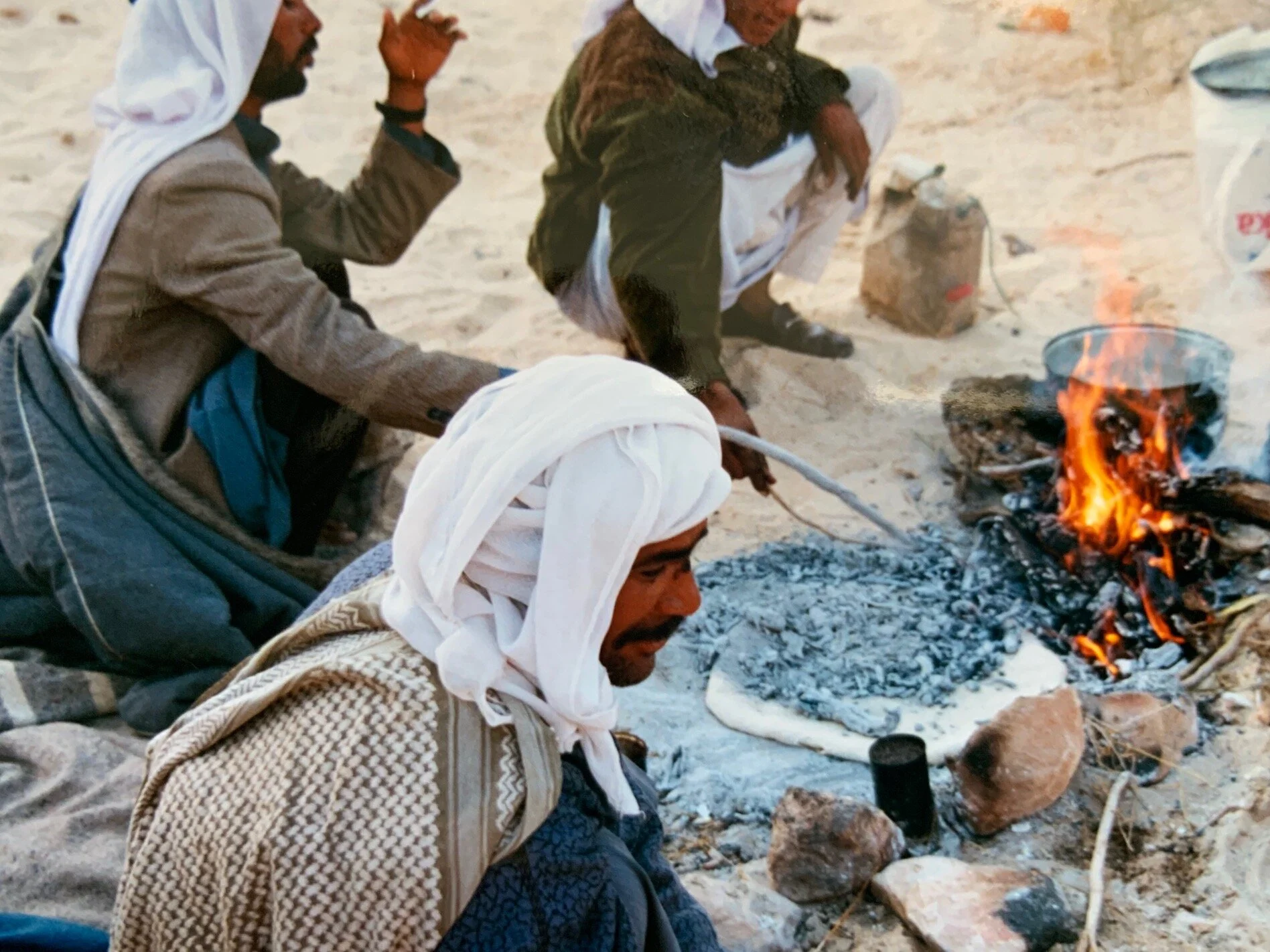
We hired a team of Bedouin tribesmen, and they served as guides, camel herders for our camels, camp setup team, cooks and storytellers. When we met up with our Bedouin guides, they offered us camels to ride. Those of us who had already experienced this MOST uncomfortable means of transport declined the offer and said that we would walk. The ones who wanted to ride joined us on the ground after a few hours perched on a camel’s back. So we all wound up walking. After all, this was a trekking adventure. The camels were our beasts of burden as they carried all our supplies.

Part of our Bedouin team would ride ahead of us and set up our tents and prepare the campsite.

Our chief guide frequently commented on the beauty of the terrain. He would often say, “Look at this beautiful scene. Isn’t this the most beautiful thing you have ever seen?” We decided that our guide was really into earth tones because all we saw was the same brownish colored panorama. However, there were wide open plains and surrealistic sandstone hills and rocks carved by winds, flat topped ranges and plateaus with dramatic views, rugged mountains in the distance and a maze of long winding wadis and hidden canyons that had formerly carried away rainwater. Beauty is truly in the eyes of the beholder!

I had discussed with our guide about the desire to have some team-building experiences, and he asked me to explain this. He caught on to the idea and carried us through some very narrow vertical openings carved in the sandstone thousands of years ago by heavy rains. They were like 24” wide shafts, and the only way to maneuver up or down was to use your knees, buttocks, shoulders and hands to inch along—with the encouragement of your teammates either above or below you.

The Bedouin fascinated our team with their familiarity of the land, with utilizing the camels, knowing how to make us feel comfortable in a strange desert, but most of all in making bread. They built a fire in the sand, and while one of the Bedouin worked the coals out of the fire into a separate pile, another was making bread. The bread maker looked like he was making a pizza crust—throwing it into the air and rolling it around in his hands. His colleague spread the coals, and suddenly, the bread maker threw the bread dough on top of the coals. Then they spread more coals on top of the bread. The next step convinced all us trekkers that we were not going to eat any bread that night. They covered the coals and bread with sand!!

After a few minutes of sipping hot, sugar-laden tea around the fire, they uncovered the bread and it was golden brown with a crispy crust. One of the Bedouin knocked the bread against his arm and the sand and black ashes fell off.

They served that bread (and several more loaves) to us with wild honey harvested that day. Miraculously there was no sand on the bread, and we all agreed that was some of the best bread that we had ever eaten.

NAME RLT Sinai trekking 1999

NAME RLT Sinai trekking 1999

Sinai bread

Sinai bread

News

Long ago I stopped watching news on TV, so I get most of my news from news apps and news podcasts. I have friends who talk about how good the news is on NPR, CNN, Fox, BBC, Reuters, and others, but frankly they all insult the intelligence of this Mississippi farm boy. I actually prefer to read the Al Jazeera news app, even though it promotes a Muslim worldview, because I don’t get US political party bias. Plus, it has good coverage of world news that our sensationalist US-based news outlets do not adequately  cover.

The USA network newscasts are so politically oriented not just towards political parties or public offices, but to influencing our culture and our way of life. Media companies do not do news anymore. They give opinions! On the news apps I must wade through the “opinion” articles to look for the headlines. Have you ever noticed how much today’s news focuses on what celebrities think about ethical, social and political issues? Who cares what a sports star or media star thinks about those issues!

During my years as an administrator in Richmond, I was tasked with the responsibility of facing news outlets when there was a tragedy with some of our personnel overseas. There was loss of lives in several countries during that time, including Yemen, Philippines and Iraq, and all the national and international media wanted an interview. I do not have fond memories of interviews and press conferences during that season. Of course, the loss of lives—some of them my friends—was tragic and that is definitely not a good memory, but neither was relating to the media folks.

We were so fortunate to have Wendy Norvelle working in PR during that difficult time. She and I had received some crisis communication training prior to these tragic events, and we were usually able to steer the interview back to the message that we wanted to get out to the public. But it was a huge challenge as many of the big names in the media world were very talented at trying to get us off our message and onto their slant on how they wanted to report the news.

One time when Cheryl and I were serving with NAME and visiting with a family who lived in the West Bank, the TV was on in another room in the house and one of their kids called to us to come and look at what was on CNN. There was a riot going on as protesters were clashing with authorities and the news announcer made it sound like the beginning of World War III. According to the newscaster this “riot” was going on two blocks from their house, and we did not even know anything was happening. When we looked outside, we could see a satellite truck and a small group of people down the street, but it was definitely not a riot.

People love sensational news. Look at how much more our TV shows are graphically violent and look at all the crazy reality shows on the air.

In late October and early November of 2010, I led a team of Owner/Operators and home office staff from Chick-fil-A on a discovery trip to Haiti. We were looking into the possibility of partnering with a ministry with orphans in western Haiti. In January of that year Haiti suffered a devastating earthquake, and our team was also setting up a project to help build some homes for people who had lost their homes to the earthquake.

While we were in Haiti, hurricane Tomas hit western Haiti, and we were forced to ride out the hurricane at an orphanage in Port-au-Prince. The winds and rain subsided, and we needed some food, so we found a restaurant that had a generator and we ate a meal there. The owner of the restaurant had a television tuned into CNN International. We could not believe what the reporter was feeding to the world. He was reporting live from Port-au-Prince where we were, and he looked like he was about to be blown away. He was stumbling to stay on his feet. The reporter’s microphone was picking up strong bursts of wind that altered the transmission. We all looked at each other, and then we looked outside, and one of the team said, “He must be on another planet.” The winds had never reached the strength that the TV was displaying. But he was a very good actor with some very good props—all to produce some sensational footage for a hungry audience.

The Bible is a collection of newscasts that tells many stories, but the main story is about the Good News that God loved the world so much that He sent his son, Jesus Christ, as a one time sacrifice for the sins of all mankind. Now that is Good News!

When I was in college I bought a copy of the Good News Bible.  I still love that translation of the Bible. I love to talk about the Good News message of the Bible. Too bad that our newscasts are more interested in sensationalism and opinions than good news.

Guest Story by Elias Moussa

Guest story by Elias Moussa

After reading my blog entitled “LOT memories,” Elias Moussa sent me this story. Enjoy.

Did I ever tell you about what happened in Djibouti when John Brady, Jeff Pearson, Jay Owens (chairman of committee for NAME) and myself?   We traveled from the capital to the small town of Tadjoura by car to stay at the house of Joe Dobbs who was on STAS.  It was a hot day, as usual.  Upon entering the house, we checked and agreed on the sleeping arrangement.  We agreed that John and Jeff would sleep in the master bedroom sharing the king size waterbed in the air conditioning.  Jay Owens would sleep in the other bedroom with a single bed and air conditioning.   I volunteered to sleep on the couch in the living room without an air conditioning.

After supper, we retired each to his place.  I managed to sleep well until about 4 a.m. when I heard some really strange noise— very close to me— in the same room.  I stretched my legs and I felt something soft at the end of the couch.  Noise and something soft under my feet. Scary!   You have to remember that the house was not airtight and there were all kinds of noises throughout the night.    I wondered if an animal managed to creep in, but why my couch where I am sleeping.  I gently lifted my head to see what was that thing at the end of the couch.   It was John Brady sitting in his stretchy style when he sleeps--snoring away. As you rightly said, “he can sleep anywhere.”

Here is the end of the story as told by John Brady over breakfast. “Jeff Pearson turned over, causing a huge tsunami which sent me tumbling to the floor. “ 

How can you ever forget such travel with people you love and admire? Thank you, John and Larry, for unforgettable days.

Pay It Backward and Forward

I was on the phone today with a friend who has a ministry with high net worth families. He and his colleagues send couples who have successfully charted legacy plans to meet with other couples who are struggling with how to balance their wealth and their desire to use it for God’s glory.

My friend said that his ministry is able to provide these services to build enduring family legacies with no charge to the recipients. Their secret sauce is this: families who have been helped in the past give to the ministry so that others can benefit from the ministry. That is called “paying it forward.”

After we finished our video meeting, I thought about what was often reported in the Chick-fil-A family when I was working with their ministries. It was always good to hear reports from the Customer Care department about stories from a drive-through customer (and sometimes even at the checkout counter inside—remember when we could do that?!) who would ask to pay for the order of the car behind them in the drive-through line. That was also called paying it forward, but I never understood that one. The drive-through customer was actually paying for the person BEHIND her/him, so how could it be paying it forward. Anyhow, I called that paying it backward.

That’s what happened when I asked Jesus to come into my heart. He took upon himself the burden of my sins of the past—paying it backward—and my sins of the future—paying it forward. Thank you Lord that you paid the check backward and forward, and my part of that transaction is to confess, repent, believe and transform to live to be more like You every day for the rest of my life.

LOT memories

I was on the phone today with John Brady, and afterwards I was reminiscing about some good times our old NAME team had together. We were given a difficult task, but God brought the right team together to change the culture and focus on people groups in our part of the world.

I have so many stories about working with this team, but here I will only share a few.

Mike and Madelyn Edens lived in the Middle East for 25+ years, and Mike had traveled extensively in that part of the world. However, he became persona non grata in a couple of those countries. I learned the hard way that it was best not to go through immigration with him. Yes, I was detained along with him just because I declared that I was traveling with him. I thought that would be a good thing since he was so experienced, and I was a novice in that part of the world. Wrong! It was a liability.

Mike Barnett declared to our team during our first retreat in Kandern, Germany that he would not be traveling. He was adamant that he “did not do travel.” While we were walking back to our lodging from the Italian ice cream shop in the small village of Kandern, we saw that people had placed unwanted things on the curb for pick up by the recycling people the next day. Someone had decided to give away a piece of luggage, so one of our team members picked it up and stopped and made a presentation to “the man who does not travel.” From that point on Mike B was referred to as the man who does not travel. Interestingly, during his service on our team, he traveled as much as his teammates.

John Brady and I were traveling together in Chad. Our family had lived in West Africa, and Chad is so similar in many respects to where we lived in Burkina Faso. I was enjoying introducing John to some foods and culture in Chad. We stayed in a guest house that had fans—a much appreciated luxury where the nightly temp may be 100 degrees in the house at bedtime. During the night, John woke me up, and said, “Your computer is making a beeping noise.” I told him that it wasn’t my computer, but it was fruit bats. I went back to sleep, but in less than an hour I was awakened by John asking me if I would do something about my computer. “John, that is not my computer. They are fruit bats.” Before another hour, John woke me up and said I can’t sleep because of your computer noise. Now, anyone who knows Brady knows that he could sleep through a hurricane. He is the only person I have ever traveled with who goes to sleep on the plane BEFORE the plane takes off! Finally, I sat up on my bed and gave him a short lecture on the nocturnal sounds of fruit bats.

Elias and Linda Moussa had lived for years in Cyprus. Getting them to move to London where our team would be based was a challenge, but they are team players, and they made the move with less than expected anxiety. Elias was trying to fit into the British culture, so he was wearing a tie to the office each day. One day while leaning over the paper shredder, his tie was caught in the shedder. Fortunately, he was able to quickly shut it down. Elias is such a good sport, and he wore the six-inch tie for the rest of the day.

Gerry Volkhart was a real trooper to put up with five male extroverts who all talked excessively and usually very loudly. In more meetings than I can count she was the wise one with her infrequent, but potent counsel.

This team was given the task of blending personnel from four different “areas” of the world who came from different work cultures and had different strategies for reaching their part of the world. It was a difficult time of changing directions in mission and strategies, and there was resistance from some long term workers, but the Lord provided the grace, patience and wisdom. This team put their hands to the plow and set the pace for other regions of the world in moving towards a people group focus with a vision of church planting movements in our part of the world and beyond.

This was the most intense team that I have ever worked with. As long as he was alive, Mike B liked to call our team “LOT”—Larry’s old team. Mike would be happy to know that some of our old team still likes to get together at least once a year.

Remembering Pete

Today would have been my dad’s 93rd birthday. He rests in his eternal home with the Lord since September 9, 2019. I don’t just think of him on his birthday. I have missed him.

While I was growing up, my family went to church regularly, and my parents even made sure that I was in church on Sunday night. It was in Training Union that I received my first exposure to getting up in front of people and feeling comfortable, and it was in Royal Ambassadors on Wednesday nights where I first learned about missions.

My folks become even more serious about their involvement in church work when they agreed to be the first members of a new church plant in our town. It was there as a teenager that I first felt that the Lord wanted me to do something vocationally in ministry.

My dad worked his way into being the treasurer of the church, so he could influence giving to the Cooperative Program. In his retirement on limited income he never stopped tithing, and he always made sacrificial gifts to missions offerings.

I never in my life met or heard of a person who did not like Pete. Everyone knew Pete as a man of integrity and a man who kept his word. His given name was James Wesley Cox, but not many people ever knew that name. They all knew him as Pete Cox. People would say his name so fast and run the name together so that many people thought that he was called by his last name: Peacock!

When I was a boy, I noticed that Pete would raise his pointer finger from the top of the steering wheel when he was driving. One day I asked him why he lifted his finger every time we met a car while driving. He told me that was his way of waving at the driver of the other car, and that he was just trying to be nice to everyone. When I received my driver’s license at 15, I started the same practice, and you know what—many people responded and waved back at me. If I did that today… What a shame that simple things have become complex and even offensive in our culture.

When I was 10 years old Pete started coaching baseball. He loved baseball, but he loved working with boys even more. He coached for about 10 years as one of my brothers is five years younger than I am, and Pete also coached some of his teams. At Pete’s celebration of life service last September, there were several older men at the visitation who were telling baseball stories about Pete and reliving their Little League playing years. Pete had coached all of them.

My dad trusted everyone, and most of the business deals that I recall him making were done with a handshake, not paperwork. One of those handshakes turned out very badly for him. He helped a man start a food vending company, and for 26 years he managed that business and grew it from a small business to a medium-sized business that made a lot of money for its owner and employed 20 people. Pete never received any retirement benefits during those years because the owner promised that he would always take care of him. After Pete had invested 26 years of his life in that business, the owner sold the company to a chain of food vending companies. The owner told Pete not to worry because he would continue to work for the new owners. However, there was never any mention of any pension or retirement payments.

If that happened to me after investing 26 years and expecting someone to “take care of me,” I would have lost it. But not my dad. To make matters worse, the new owner fired Pete a year after he purchased the business. By that time Pete had introduced him to all of his connections and relationships in the vending business.

We were living overseas at that time, so we only had the “air letter” version of the struggles that Pete had getting a new job at age 56. It was a crisis in his life, but his faith kept him focused on the Lord, and his character kept him from living in the past of what could have been or what should have happened.

The Lord was faithful to my dad and mom and they had 72 years together. They did not have a lot of money for retirement, and they were not able to have many of their “wants” during retirement, but the Lord took care of them, and I never heard my dad say that they were short of money or that they could not buy something that they needed.

My dad, Pete, taught me about integrity and having character that others would respect.

He helped me as a young boy to understand that I must have a moral compass that does not waver but holds steady no matter what the situation may be.

Proverbs 28:6 states it well: “Better is a poor man who walks in his integrity than a rich man who is crooked in his ways.”

Heroes

A friend asked me to listen to a presentation by a former worker in a restricted access area of the world. The presentation was made in a church and my son and I watched it on YouTube. Let us call the former worker “Alex” in my story.

After a glowing five-minute introduction by the pastor, Alex took the stage and began talking about himself. Fifty minutes later he closed talking about himself! To make his speech more appropriate for a church setting, he wove in a scripture passage every now and then. Otherwise, he could have given the same speech to the Rotary Club—but they would have cut him off after 20 minutes because the members only meet for an hour and that includes eating and all their business discussions.

I know—I have already set the stage for a negative story about Alex but hold on because I will finish on the positive side.

Alex based his speech around an encounter that he had with some purported government authorities who wanted to take his life because he was affiliated with the CIA. He drug this story out so long by adding humor to the life and death situation. Then he told the story of his life backwards ending up with yet another story about him—of course—when he was 17. I won’t bore you with any more details of his self-gratifying stories.

Jason and I fast forwarded the video occasionally, but we listened to most of it mainly because we wanted to see if he breeched security with his stories. However, that was not the major concern. More uneasiness was caused by Alex’s implications and hints that he was with the CIA while serving as a worker.

Alex’s speech did give Jason and me an opportunity to have a conversation about heroes. An amazing thing is how much the congregation seemed to enjoy his stories even though the focus was clearly on him. Much of today’s culture promotes heroes. The challenge is that most of America’s heroes are celebrities—those who sing or rap about a myriad of themes (some decent and some indecent), those who play professional sports making and spending exorbitant amounts of money and having lifestyles  that we don’t want our children to emulate, political figures, tele-preachers, and on and on.

Who are the real heroes? I loved listening to Paul Harvey on the radio while growing up. He actually talked about good news and told stories about people who in my mind were real heroes.

Later that day the Lord brough to my mind a person from my past, and I think it was because he was a real hero. When we arrived to serve in Burkina Faso in 1980, our family was met by Ina and Bryant Durham. This is one of the most unassuming couples that I have ever known. They were soft spoken, but Bryant could raise his voice when he thought it was necessary. Their southern drawl gave away the Georgia roots, and it made you relax when talking to them. Bryant was a southern gentleman, but he was no county bumpkin. He had a PhD, but his wisdom was not all classroom based. He was a wise man who made hard decisions based on the facts and occasionally threw in a bit of compassion and grace.

Bryant and Ina stayed in Nigeria serving the Lord and the people they loved when the Biafran War broke out. They wound up being on the wrong side of the war when the war was over in January, 1970, and they were never able to return to Nigeria to serve. The mission board asked them to come to Upper Volta to open work in this country for the first time. Bryant served in Ouagadougou as the Mission Treasurer and in many other leadership positions until their retirement in the mid-1980s.

Bryant will never be recognized by those who did not know him. He was not a pastor or polished public speaker, and I doubt that he ever gave a speech promoting himself. He never called attention to himself. He was a quiet reserved gentleman who walked with the Lord and made sacrifices to serve the Lord in West Africa for 30+ years. To me he was a hero.

Who's listening?

While waiting for my PET and CT scans at Emory recently, I was frustrated about wearing my mask. I was alone in a small examining room for two hours because the scanning machine was malfunctioning. They had already injected the radioactive substance for the PET scan, so I just had to wait for them to get the machine functioning properly.

I had to wear the mask because one of the technicians would come into the room every 10-15 minutes to check on me and give me a report. The problem with the mask was not being uncomfortable. The problem was that my iPhone would not recognize me with the mask on.

I was alternating between doing some work, working a word puzzle, reading the news and dozing off. Every time I dozed off or paused for a few minutes to think about something, I had to take the mask off to get back into my phone.

We are so wed to our devices! I am guilty. As you probably do also, I get a weekly report on my screen activity on my iPhone. I am stunned some weeks by the average number of hours I spend on the phone each day.

Over the weekend we were playing Mexican Train with Jason and family. It was fun and no one took out their devices during the long game, but the minute the game was over, and the dominoes were stored away, all of us checked our phones.

Allison gave me an Amazon Echo for my birthday. We still have an old stereo system that has a six CD changer and good speakers, but now I would rather ask Alexa to play some of my favorites.

Cheryl does not like Alexa. She declares that Alexa can hear our voices all the time. I know she does not like me keeping it plugged in all the time, and I have not seen her giving commands to Alexa—except “Alexa, stop” or “Alexa, pause.”

I did some research on the web—where you find everything!?—and it is true that Alexa and other devices are listening. However, they are not recording until they are awakened. So there are some risks.

This morning I was reading about David’s flight from Saul, and this verse grabbed my attention:

“In my distress I called to the Lord;
    I called out to my God.
From His temple He heard my voice” 2 Samuel 22:7

The original voice recognition, pupil recognition, and facial recognition was owned by the Lord God Almighty. God not only recognizes our voices, but He hears our voices as we communicate with Him. That brings peace to my heart and soul.

P.S. I am unplugging Alexa right now and only plugging it back in when I want my music.

Follower

Due to some family health challenges, our family departed Burkina Faso in 1987 and returned to live in the USA. On the return trip, our family met Cheryl’s dad and stepmother in Paris for a vacation in Europe. We rented a van and toured France, Germany, Austria and Switzerland.

Cheryl’s dad, Maurice, had served in the army in Germany, so he wanted to retrace some of his experiences. He was one of the guards at the Nuremberg war criminals’ trials. He served as an officer in the compound where Speer, Hess, Goring, and other Nazi leaders were held in jail for the post war trials.

The court room in Nuremberg where the trials took place is not open to the public, and that was a huge disappointment for us. Maurice was a determined man, and he persisted, using broken German he retained from living there forty years before this visit. Finally, he convinced the guard that he had served as an officer for the famous Nuremberg trials, and the guard called for someone to come and give us a personal tour of the courtroom.

Maurice took us to the historic parade ground just outside Nuremberg which was Hitler’s most powerful pulpit where he amassed troops covering the 7-acre field. He told us about US troops blowing up the giant marble swastika that overlooked the stadium and parade grounds.

In Berchtesgaden Maurice directed us to the site of a former retreat for German officers. The retreat compound is located below “Kehlsteinhaus,” Hitler’s Eagle’s Nest. Before all the buildings were destroyed after the war, it was used as a retreat for R & R for Allied officers. Maurice remembered where every building stood and where he stayed. He pointed out an indentation in the ground and told us that had been a swimming pool.

As we walked over the grounds, I noticed that an older couple was following us closely and listening intently to what Maurice was saying. I turned to face them and smiled and greeted them, and they returned the smile and greeting.

When we returned to the van, we were getting refreshments for the kids, and the couple who had been following us approached us. The woman did the talking and told Maurice that he did a good job describing the retreat grounds. She went on to inform us that they were Austrian, and both were physicians. Then she said something that surprised us: they were not only Nazis, but her husband served during World War II in the SS. That was an eerie feeling, but then she showed us an old photograph of Hitler with a girl with braided long blond hair and blue eyes. Then she told us that she was the girl in the photograph. Many German troops carried a copy of this photo in their pockets as a reminder of the Ayran race and why they were fighting.

We were already blown away by all this information that she shared with us, but as they said goodbye, the lady leaned in closer to us and said, “If Hitler were alive today, we would still be his followers!!”

Now that was an unnerving surprise. I wondered how many other people today shared their conviction about being a follower of Hitler.

I thought a lot about that word “follower.” In many parts of the world a believer does not identify himself as a Christian because that word is associated with the slaughter of tens of thousands of Muslims during the crusades of the Middle Ages. Particularly in the Muslim world believers identify themselves as “followers of Jesus.” For those who declare themselves as followers of Jesus there are great sacrifices—their family usually disowns them and shuts them out of their lives; they are unable to find a job because they are branded as rejecting the true faith of Islam; they have difficulty finding a place to live; and their personal property is attacked.

I looked up synonyms for follower in the dictionary: acolyte, adherent, convert, and disciple. The dictionary also stated some words related to follower: apostle, missionary, proselytizer, soldier, loyalist advocate, backer, champion, devotee, worshiper, and zealot.

As I typed those words, I had to stop and think about my own commitment to Jesus related to each of those words. Wow! The question still lingering in my mind is this: How does my journey as a follower of Jesus stack up to each of these words? Am I really a soldier for Christ? A zealot? Would anyone say that I champion Jesus?

May the Lord renew my heart and mind to be a true follower of Jesus Christ!


One potato, two...

After a year of language study in Tours, France, Cheryl and the boys and I were anxious to move to our assignment in Abidjan, Ivory Coast. We had to vacate our apartment in Tours as another family was arriving to begin studying French. They had to move in on a certain date in order to have time to begin the new semester of language school. However, our house in Abidjan would not be available for us to move into until two weeks after the departure date from France.

We decided that since we had to depart France and could not arrive in Abidjan that we would spend the two weeks of waiting with our friends in Lomé, Togo. Rex and Sherry Holt’s year in French language studies had overlapped with our first six months, and this couple had become very dear to our family.

Our time in Lomé was so refreshing as it was our introduction to the continent of Africa, and it was spent with good friends. Plus, we were able to meet some new friends who have been significant in our lives to this day.

One night our family and the Holts were having dinner with Bill and Evelyn Bullington and their two sons, Kirk and Bryan. Evelyn had prepared a great meal, but to this day, no one remembers what we had except for the baked potatoes.

Something I understood early on living overseas is that you do not learn everything by mastering the language and culture alone. I do not mean to minimize the importance of language acquisition and cultural understanding, but there are other important things to learn—like when your host in West Africa serves you baked potatoes, you are a special guest. Potatoes are not a staple in West Africa, so the only potatoes grown are usually sold to westerners. They are small potatoes, but they cost big bucks.

Evelyn served everyone a baked potato along with what I am sure was a delicious meal. My potato looked delicious, but when I cut into it I discovered that it was bad. I did not say anything, but Evelyn being the great hostess that she is asked if my potato was ok. I had just become acquainted with these wonderful folks, so I could not say to her that it was fine.

She quickly removed the potato from my plate and served me another one. I cut into the second potato, and I was really embarrassed—it also was bad. Then I cut into the third potato, and I could not believe it. The third potato was also unpleasant. Now the irony of this situation is that I was the only person at the table set for 10 people that received a bad potato.

Evelyn told us that she had cooked extra potatoes because they were so small, but she had no idea that she was cooking extra spuds for me. I recall making a comment something like this, “That’s ok, Evelyn, it is not your fault because it looks like I attract bad potatoes.”

I was talking with a friend today about this—not the potatoes, but the attraction. It seems that when we are doing our best in following the Lord that the devil seems most attracted to us, and he works the hardest to distract us from our loved ones and tries to draw our attention to something else that is trivial, off color, unprincipled or maybe even immoral. Satan wants to get in the middle of what is right and sow seeds of doubt, despair, doom or maybe even seeds of temptation.

Our job is to stay focused on Jesus who will pilot us through these challenging times when we doubt our ability to stay the course. “No temptation has overtaken you except what is common to mankind. And God is faithful; He will not let you be tempted beyond what you can bear. But when you are tempted, He will also provide a way out so that you can endure it.” I Corinthians 10:13.

Scans update

I had a CT contrast scan and PET scans of my head and body on June 29 at Emory, and I had an appointment with my radiation oncologist yesterday at Emory. His very first words upon arriving in my exam room: “I have an encouraging report for you today.”

With the help of research on the web, I have read the scan reports a few times, and here is my layman’s summary: No evidence of recurrent disease in the primary site (sub-mandibular salivary gland). No abnormal lymph nodes in the neck. No suspicious lung nodules. In the brain, spine, and digestive tract there are no aggressive lesions suspicious for metastatic involvement.

We are grateful to the Lord for this good report. So many of you have been such an encouragement to me and my family during the past nine plus months. What a blessing to have our common bond through Jesus Christ. Thank you!

Red and yellow, black and white

When it comes to discussing the facts about a situation, I have consistently been a black and white person. I don’t like for people to speak to me in grays, but I want the facts given to me straightforward. I have worked with people who talk around a problem, and I finally have said to them, “Just get to the point please.” I realize that I have probably hurt some colleagues’ feelings in the past by not letting them fully express themselves, but my nature is to be a problem solver, so once we know the problem, let’s get on with fixing it—not continuing to talk around the problem.

When it comes to morality and ethical issues, I have also thought of myself as a black and white person. When it comes to opinions about food, I don’t remember saying “I kinda like this.” I either like it or I do not like it. I realize that using the expression “black and white” is used by some to criticize people like me who they think are judging or showing complex situations in a simple way. I know that you cannot see everything in the world in black and white, but I just like the unambiguous.

The words black and white have dominated the media headlines for the past six weeks. Whenever a news release is written it usually identifies the skin color of those involved.

An Australian friend called me recently. He was proud of the way that Australian authorities had contained COVID-19 outbreaks in Australia, resulting in a low number of cases in the country. He also asked me about the social injustice turmoil in the USA and mentioned that what was going on in the USA was also affecting public sentiment for the historical treatment of the Aborigines in Australia.

He made a statement that has been bothering me since our FaceTime visit. He said something like this: “As long as America media talks about blacks did this and a white person did this or the suspect is an Hispanic male, then there will be more and more problems in the USA. Why do you have to distinguish people by the color of their skin? All of them are Americans, so stop identifying black, brown, or white people in your media reports.”

Since he talked to me about this, I have been monitoring the news more closely, and you know what? My Australian friend is right! The media does not have to report every incident by naming the color of the skin of the accused or the victim. I know that information like this is helpful to law enforcement in trying to apprehend the assailant, but it is not necessary for me to know the skin color. As I think about this I realize that I have to think about terms that I use to describe something to someone else. Am I modeling what I want the news media to do?

When I was in the beginner department of Sunday School, I learned a song that I often sing over and over in my head. “Jesus loves the little children, all the children of the world. Red and yellow, black and white, they are precious in his sight. Jesus loves the little children of the world.”

The words are a good reminder that Jesus does not focus on the color of our skin, and He loves everyone as much as He loves me.